
by Brenda Spiering
Most transatlantic cruises today are repositioning cruises. They’re offered by cruise lines looking to move ships from one region to another – typically from the Caribbean to Europe in the spring and back again in the fall.
Fall crossing (when Mediterranean-based ships are headed to the Caribbean)
My first cruise across the Atlantic was in the fall. I’d come across a promo for a Royal Caribbean cruise from Barcelona to Fort Lauderdale. The price seemed too good to be true. It was a 15-day voyage and cost less than half of what my husband and I had paid in the past for a one-week cruise. Crossing the Atlantic by ship had been on our bucket list for a while. We were in!
Never having been to Spain, we were excited to spend a few days sightseeing in Barcelona first. The city was wonderful. And we understand the lineups to see historic attractions such as the famous Gaudi-designed church, Sagrada Familia, were far shorter than during the summer months.
But weather-wise the daytime highs only reached into the mid-teens and the nighttime lows were around 7C. Plus, the sun set by 5:30 pm. Most of my memories of strolling the Rambla (Barcelona’s famous pedestrian boulevard) are of doing it after dark. And I couldn’t help but look longingly at the cold, deserted stretch of beautiful beaches lining the coast.

Having only experienced cruising in the calm Caribbean, I was also surprised by the rougher seas we encountered. Apparently, the Atlantic tends to be rougher in the fall than in the spring. While neither my husband nor I suffer from seasickness, there was one day in the middle of the crossing when the outdoor decks were closed for safety.
Don’t get me wrong. We still loved the cruise. But then we’ve never been on a cruise we didn’t love. I also realize some of my disappointments were my own fault. A novice ocean-crosser, I’d paid little attention to the itinerary. We completely missed the Strait of Gibraltar, passing through it in the inky black of night.
I’d also neglected to research anything about the Canary Island of La Palma, our final stop before we headed out to sea. Instead of the lush green paradise I’d expected, we arrived to discover an island extensively covered by hardened grey lava with no vegetation in sight – the result of a 2021 volcanic eruption. (Apparently, the flora will slowly regenerate, but it will take decades.)

Spring crossing (when Caribbean-based ships are headed to the Mediterranean)
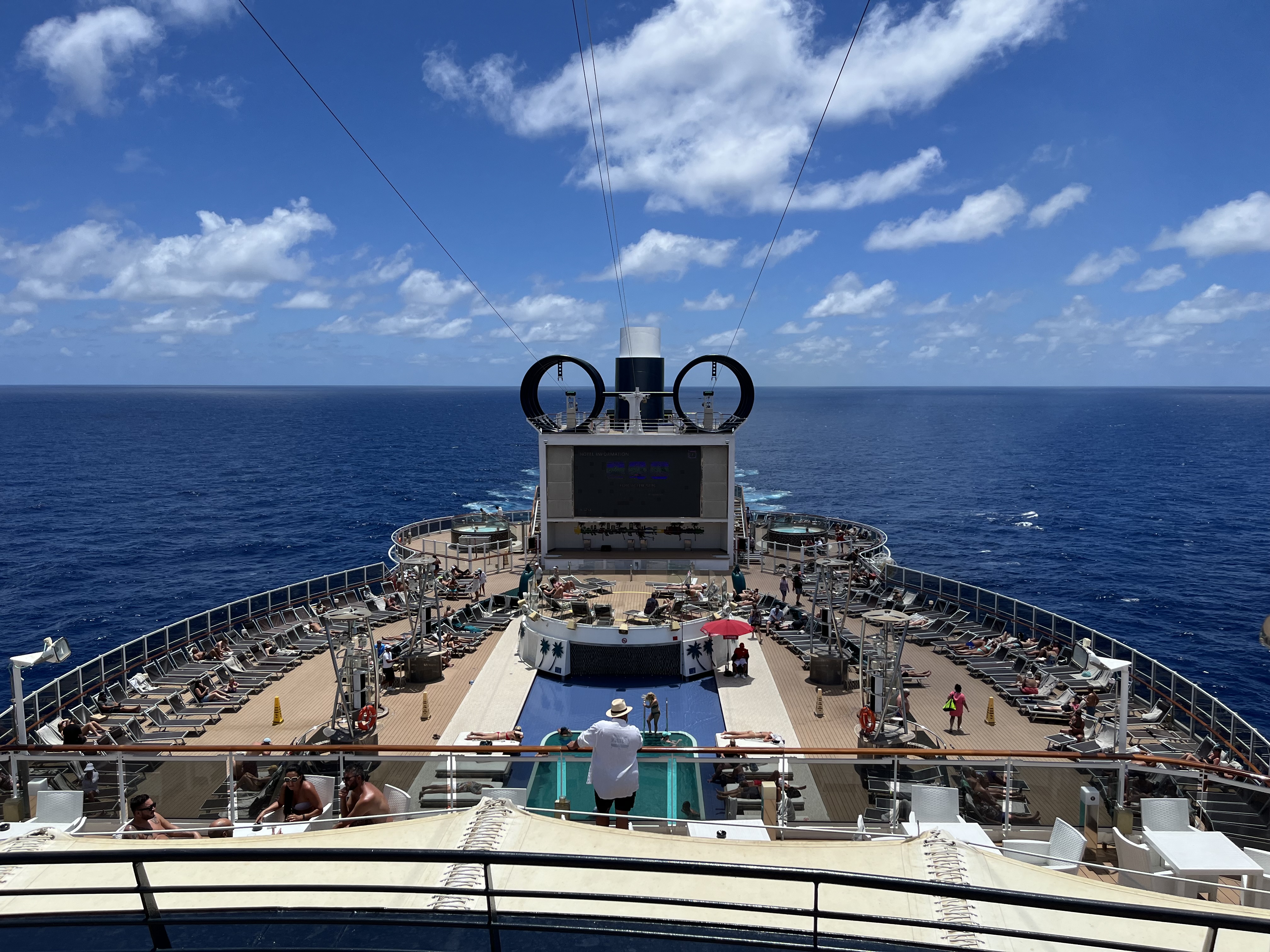
My second cruise across the Atlantic was in the spring. Having learned a few things from my first crossing, this time my focus was on the itinerary, and I found a great one. It was an MSC Cruise crossing the Atlantic from Miami to Marseille, stopping first on several Caribbean islands and then circling the Mediterranean with stops in Portugal, Spain and Italy, before reaching its final destination in France. Once again, the price was fantastic.
Along with the cost, the first thing I loved about the cruise, after a long, cold Canadian winter, was that it started in the Caribbean. Not only did we get to enjoy some beautiful Caribbean islands, but nearly the entire voyage across the Atlantic was at roughly the same latitude as Barbados. That meant we had six wonderfully warm – and relatively calm – days at sea.

There was also an advantage in starting the trip without a long flight and huge change in time zones. Ship time adjusts gradually over multiple days, so when crossing the Atlantic by ship from west to east you arrive in Europe with no jet lag.
Spring is a glorious time to tour Europe. The sun doesn’t set in Spain in mid-April till around 8:30 p.m. That meant an extra three hours to see the sights. And, having carefully checked the itinerary this time, not only did we get to visit a greater number of European ports, but we got to experience a beautiful mid-day crossing through the Strait of Gibraltar.

Using the ship as transportation
Something worth noting is that my recommended time to cross the Atlantic is very much from the point of view of a Canadian tourist. On my first crossing, I got to know a German couple who told me they own a vacation home in Florida and regularly take repositioning cruises to cross from their home in Europe to North America each fall and back again each spring. In their case, the ship is an enjoyable mode of transportation. They said it can sometimes cost less than the price of an air ticket.
Repositioning cruises aren’t for everyone. They involve multiple days at sea (for me, that’s a plus). Their time of year and length of crossing don’t work well for families with kids in school. But for retirees or those with a flexible schedule, they can offer both great value and an exciting journey.
How to find a transatlantic cruise
Most major cruise lines list transatlantic (and transpacific) cruise options on their websites. Some refer to them as “repositioning cruises.” Holland America and MSC call theirs “Grand Voyages.” They are also available through cruise discount sites such as:
Leave a Reply